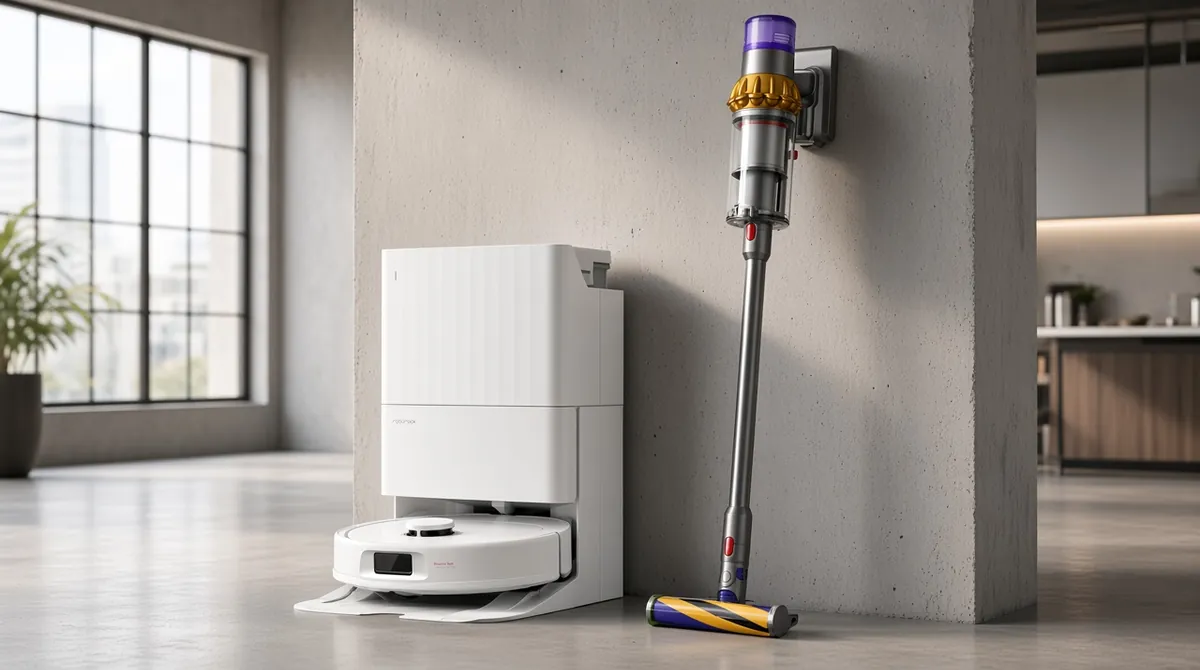
If you have between $300 and $800 to upgrade your home cleaning setup, you face a foundational dilemma: should you invest in an autonomous robot vacuum that cleans your floors while you are at work, or a high-powered cordless stick vacuum that tackles immediate messes, carpeted stairs, and upholstery? Marketing commercials often imply that a high-end robot can eliminate manual cleaning forever, while stick vacuum enthusiasts argue that an automated puck lacks the raw agitation to handle deep-pile pet hair. In reality, these appliances serve completely opposite behavioral roles. One is a passive daily maintenance system; the other is an active, multi-surface rapid-response tool.
Our analysis cuts through the hype by evaluating verified mechanical specs, user labor hours, and living space architectural limitations. To ground the comparison in real hardware, we contrast two category-defining champions: the autonomous Roborock Q Revo robot vacuum and mop and the high-suction Dyson V15 Detect cordless stick vacuum. For comprehensive floor care and home living essentials, visit our central Home & Kitchen hub.
Head-to-Head Comparison: Robot Vacuum vs. Stick Vacuum
| Comparison Dimension | Robot Vacuum (e.g. Roborock Q Revo) | Cordless Stick Vacuum (e.g. Dyson V15 Detect) | Category Winner |
|---|---|---|---|
| Core Philosophy | Passive, scheduled daily floor maintenance | Active, on-demand spot cleaning & deep extraction | Tie (Distinct roles) |
| Suction Power & Agitation | 5,500 Pa static lift / dual spinning side brushes | 230 Air Watts / 125,000 RPM high-torque motorbar | Stick Vacuum |
| Stair Cleaning Capability | 0% (cannot climb or vacuum steps) | 100% (lightweight 4.4 lb handheld conversion) | Stick Vacuum |
| Above-Floor Reach | None (floors and low thresholds only) | Couches, car footwells, ceiling vents, mattresses | Stick Vacuum |
| Daily Time Saved | Saves 15–20 minutes of daily sweeping labor | Requires active manual walking and pushing | Robot Vacuum |
| Low Furniture Reach | Slides beneath beds/sofas with >3.8" clearance | Requires bending over and moving heavy furniture | Robot Vacuum |
| Hard Floor Mopping | Pressurized dual-spinning mops with auto-wash | Dry suction only (requires separate mop tool) | Robot Vacuum |
| Floor Prep Burden ("Tidy Tax") | High: must clear socks, shoelaces, and phone cables | Zero: simply vacuum around clutter as you see fit | Stick Vacuum |
Round 1: Daily Maintenance vs. Instant Spill Triage
The fundamental divide between these two machines comes down to how messes happen in your home. A robot vacuum is an automated preventative measure. You set a schedule in a smartphone app for 9:30 AM while you are at work. The robot departs its dock, navigates your rooms via LiDAR lasers, vacuums up daily dust, pet hair, and tracked-in dirt, and returns to empty itself. When you walk through your front door at 6:00 PM, your floors feel clean under bare feet without you ever thinking about floor care. For maintaining a baseline of cleanliness in busy households, the psychological value of automated daily floors is massive.
However, real life is full of immediate accidents that do not fit a neat automated schedule. If a toddler overturns a bowl of dry cheerios in the kitchen, or a pet tracks wet garden dirt across the entryway rug, deploying a robot vacuum is painfully inefficient. You have to open an app, wait for the map to connect, select a targeted zone clean, and watch the robot spend two minutes navigating slowly out of its docking station to reach the spill. With a cordless stick vacuum like the Dyson V15, you unclip the machine from its wall dock, pull the trigger, obliterate the mess in 20 seconds, and hang it back up. If your household experiences frequent spot spills, the cordless stick vacuum is an essential utility tool that a robot cannot replace.
Round 2: Suction Power & Carpet Grooming
Marketing departments love to compare suction metrics, but robot vacuums and stick vacuums measure lifting capability in fundamentally different units. Robot vacuums advertise suction in Pascals (e.g., 5,000 to 8,000 Pa), which measures static pressure at the sealed intake nozzle. While impressive for a battery-operated disc, robot vacuums pull a relatively small volume of air (typically under 20 to 30 CFM). They rely heavily on rotating silicone or bristle brushrolls to sweep surface debris into the airflow path. On hardwood and thin flat-weave rugs, this works well. But on medium-pile carpets or wool area rugs, a robot’s shallow suction merely grooms the upper layer of fibers, leaving deep silt and pet dander trapped at the carpet base.
Cordless stick vacuums measure performance in Air Watts (AW), which combines raw static lift with high airflow volume (often 40 to 60+ CFM). The Dyson V15 Detect generates 230 Air Watts powered by a motor spinning at 125,000 RPM. When paired with a motorized cleaner head that drives stiff nylon bristles deep into carpet backing, a stick vacuum physically beats embedded dirt, sand, and pet hair loose and pulls it out of the pile. If your home has wall-to-wall carpets or plush area rugs where pets sleep, a cordless stick vacuum provides a level of hygienic extraction that no current robot can match.
Round 3: Multi-Level Living, Furniture & Car Agility
Where the robot vacuum completely falls flat is architectural flexibility. Robot vacuums live entirely on two-dimensional planes. If your home features a flight of carpeted stairs, a split-level landing, or raised door thresholds over 0.8 inches, a robot simply stops. Furthermore, dirt does not confine itself to floorboards. Pet hair accumulates on velvet sofa cushions, dust settles on horizontal window blinds, lint gathers on baseboard moldings, and crushed snacks hide between vehicle seat seams.
A cordless stick vacuum effortlessly converts into a sub-5-pound handheld cleaner in a single click. Equipped with a motorized mini-brush, crevice nozzle, or soft dusting tool, it cleans mattress seams, vehicle footwells, keyboard crevices, and high ceiling fans with total agility. If you only purchase a robot vacuum, you still need another solution—a broom, a dustpan, or an old corded machine—to handle every surface higher than four inches off the floor.
Round 4: Maintenance Burden & The "Tidy Tax"
One of the most under-discussed realities of robot vacuum ownership is the "tidy tax"—the physical labor required before the automated cleaning even begins. While modern flagship robots feature front-facing AI cameras to dodge large obstacles, smaller hazards like stray iPhone charging cables, thin sneaker laces, dropped socks, and ribbon cat toys can still wrap around the brushroll and jam the motor. To run a robot vacuum with complete peace of mind while away from home, you must walk through every room first and "pre-clean" the floors.
Stick vacuums require zero floor preparation. If there is a charging cord on the rug, you simply steer the vacuum head around it with your wrist. On the maintenance side, however, the tables turn. Flagship robots like the Roborock Q Revo feature all-in-one docking stations: they empty their own dustbin into a sealed bag, wash their own dirty mopping pads with fresh water, and dry the pads with 113°F warm air to prevent sour mildew odors. A standard stick vacuum requires you to manually empty the dirt canister after every major cleaning session and manually wash the filter under running water once a month.
The Two Category Champions
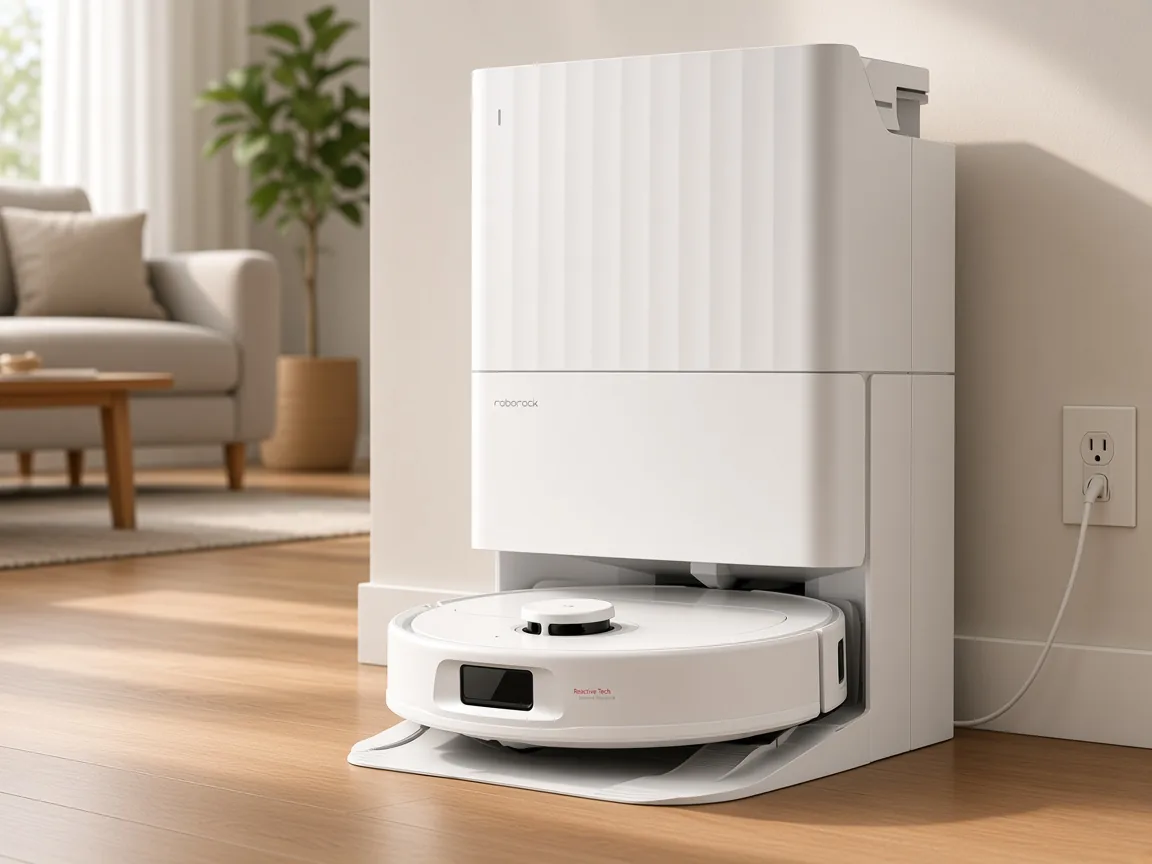 The benchmark for hands-free daily floor care, combining 5,500 Pa suction with…
Robot. Roborock Q Revo — Best All-in-One Autonomous Daily Floor Maintenance
- Suction Rating: 5,500 Pa extreme suction
- Navigation: PreciSense LiDAR with reactive 3D obstacle avoidance
- Mopping System: Dual rotating mops spinning at 200 RPM with 7mm auto-lift
- Docking Station: Multifunctional dock (auto-empty, mop washing, warm air drying, water refilling)
- Dustbag Capacity: 2.7 Liters (up to 7 weeks of hands-free dirt storage)
The Roborock Q Revo represents modern robotics at its most refined. Rather than dragging a flat wet cloth across your floors, it utilizes dual pressurized rotating mop pads spinning at 200 RPM, effectively scrubbing dried coffee splatters and muddy paw prints off hardwood and tile.
What makes the Q Revo truly transformative is the multifunction docking station. After cleaning, it sucks the robot’s onboard dustbin into an enclosed 2.7-liter dust bag, cleans the spinning mop pads against a textured washboard, and blows warm air over the pads to prevent mold. You only touch the dock once every month or two to empty the dust bag and swap dirty water tanks.
Pros
- Strong fit for its stated use case
- Clear upgrade over mushy membrane boards
Cons
- Needs clear floor plans and setup time before it cleans reliably alone
- Weaker on stairs, couches, and sudden spill cleanup vs a stick
Get the Roborock Q Revo if: You live in a single-story home with extensive hard flooring and want completely hands-free daily floor vacuuming and mopping. Skip it if: You have multi-level carpeted stairs or need an agile tool for couches, cars, and immediate spot spills.
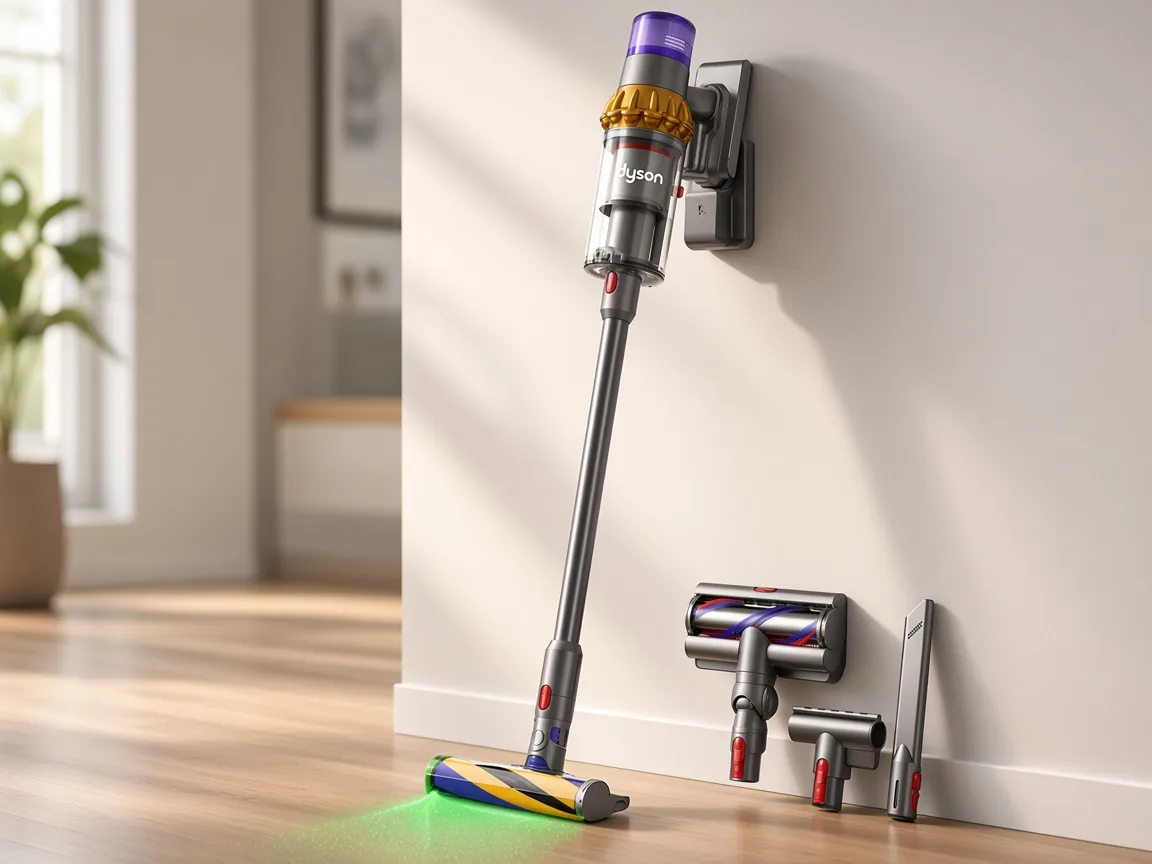 The gold standard in cordless lifting power, particle sensing, and above-floor…
Stick. Dyson V15 Detect — Best High-Suction Manual Deep Cleaner & Multi-Surface Tool
- Suction Power: 230 Air Watts (125,000 RPM Hyperdymium motor)
- Weight: 6.8 lbs (stick) / 4.4 lbs (handheld)
- Battery Runtime: Up to 60 minutes on Eco / 10 minutes on Boost
- Filtration: Whole-machine sealed HEPA capturing 99.97% down to 0.1 microns
- Cleaner Heads: Fluffy Optic laser head for hard floors + Digital Motorbar for carpets
The Dyson V15 Detect is the ultimate antidote to mess unpredictability. Generating 230 Air Watts of airflow, it pulls deeply entrenched dog fur, litter granules, and outdoor grit from carpet fibers that robot vacuums glide past. Its illuminated Fluffy Optic cleaner head reveals microscopic dust films on hardwood that look pristine to the naked eye. An acoustic piezo sensor monitors debris volume in real time, automatically ramping motor speed when you cross high-traffic entry mats.
In handheld mode, the V15 tackles the 50% of your home that robot vacuums cannot touch: vehicle seats, upholstered armchairs, mattress seams, and carpeted stair risers. The sealed HEPA filter ensures zero allergen blowback into your face during cleaning. The compromise is manual effort: you must walk the machine across every square foot of flooring yourself, and the 0.77-liter bin requires regular manual emptying. But for raw cleaning versatility, it is unmatched.
Pros
- Strong fit for its stated use case
- Clear upgrade over mushy membrane boards
Cons
- You still do the work — no hands-free daily floor passes
- Runtime and empty-bin chores interrupt long cleaning sessions
Get the Dyson V15 Detect if: You have carpeted stairs, upholstered furniture, active shedding pets, or require instant triage for unpredictable daily spills. Skip it if: You want completely hands-free automated cleaning while you are away from home, or have wrist…
The Coexistence Case: When Owning Both Makes Sense
While this guide focuses on which machine to purchase first with a single budget, it is worth acknowledging that for many busy households, the ideal end-state is a collaborative division of labor. A robot vacuum and a cordless stick vacuum are not true competitors; they are complementary partners. In an ideal setup, the robot vacuum runs automatically every weekday at 10:00 AM, maintaining an immaculate baseline across 85% of your open floorboards and preventing dust bunnies from gathering under beds. The cordless stick vacuum hangs on the wall as an on-demand spot-cleaner, brought down for 60 seconds to clean spilled coffee grounds, groom the couch before guests arrive, and deep-clean the stairs on Sunday morning. If your budget eventually allows both, they eliminate floor-cleaning friction entirely.
Which Should You Buy First? The Definitive Verdict
Buy the Cordless Stick Vacuum First If:
- You live in a multi-story home with stairs: A stick vacuum cleans the entire house, including stair treads, landings, and upstairs rooms. A robot cannot navigate vertical steps.
- You have toddlers or young children: Daily life involves sudden, localized food dropped from high chairs, knocked-over cereal bowls, and craft glitter that demands instant 30-second cleanup.
- You have fabric furniture and shedding pets: Removing dog and cat fur from sofas, pet beds, and car seats requires motorized handheld tools.
- Your floors are frequently cluttered: If clearing charging cords, shoes, and toys off the floor every morning sounds like a tedious chore, you will quickly grow frustrated with a robot.
Buy the Robot Vacuum First If:
- You live in a single-level home or apartment: Your entire floor plan exists on one continuous plane with minimal thresholds, allowing the robot to clean every room autonomously.
- Your home is predominantly hardwood, tile, or laminate: Robots excel at dust sweeping and spinning-pad mopping on hard surfaces where high Air Watt agitation is unnecessary.
- You work long hours outside the home: You value the profound lifestyle upgrade of returning to spotless, freshly mopped floors every single evening without investing manual labor.
- You have high-shedding pets on hard floors: An automated daily run prevents tumbleweeds of pet fur from drifting across your hallway, maintaining a dust-free baseline effortlessly.
Our Research Method
Nobody at Pickora ran a closed commercial testing lab or scattered measured sand across controlled test grids for this guide. Instead, our conclusions are synthesized from verified manufacturer technical schematics (Pascals vs. Air Watts, CFM airflow velocity), independent engineering teardowns from specialized outlets (including RTINGS, Wirecutter, and Consumer Reports), and analyzed long-term user feedback patterns across hundreds of multi-pet and multi-story households from November 2026. We focused specifically on real-world pain points: stair navigation feasibility, brushroll hair-tangle frequency, and the actual time saved per week.