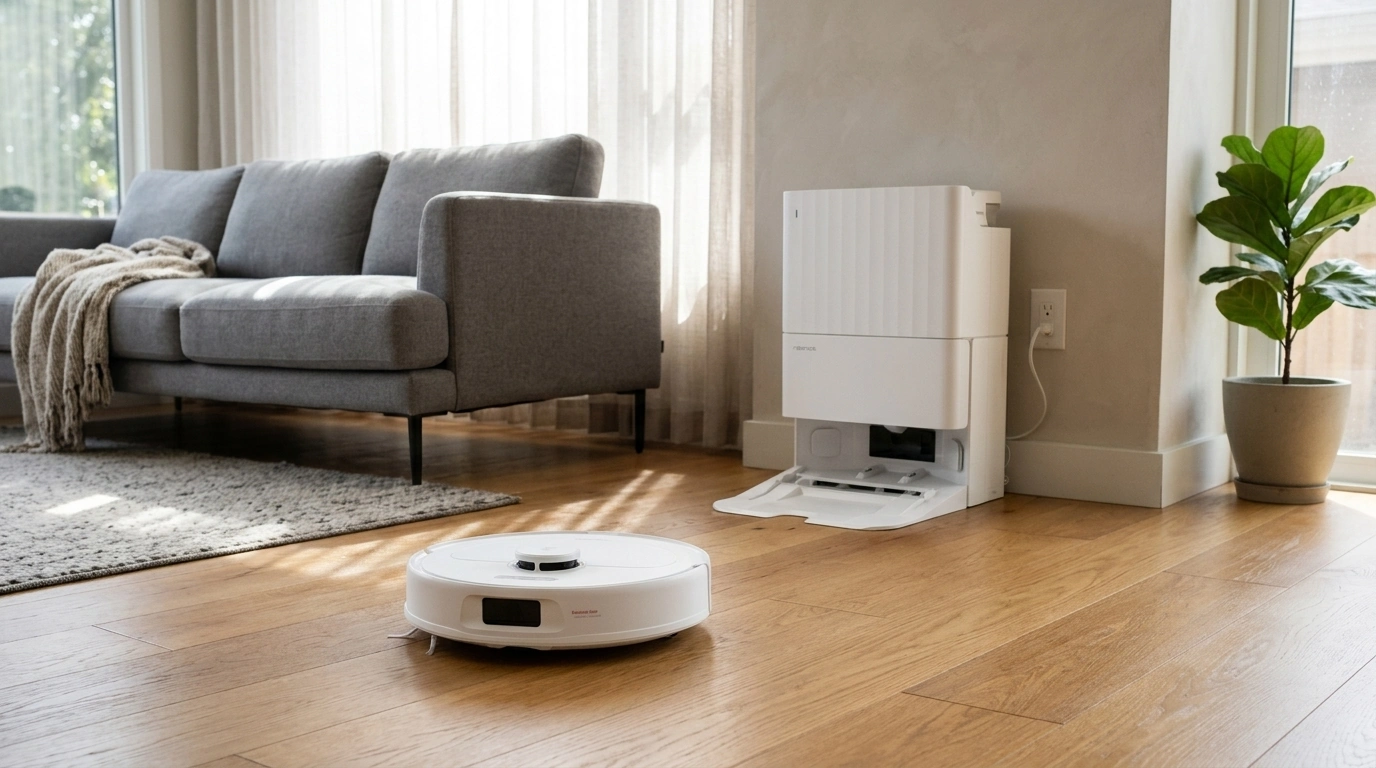
Nothing kills the excitement of a new robot vacuum faster than finding it stranded in the hallway with a charging cable wrapped around the side brush, or discovering a damp mop pad dragged across a wool rug. Spec sheets pile on Pascals, LiDAR turrets, spinning mops, and wash docks that take as much floor space as a mini fridge. The right buy is not the most expensive stack of features. It is the navigation style, mopping system, and dock size that match your floors, clutter, and wall outlet real estate.
Here is our core buying recommendation based on household floor plans: for homes with mixed hardwood and low-pile rugs where active wet cleaning matters most, the Roborock Q Revo is the clearest example of dual pressurized spinning mops and auto-lifting pad clearance. If your household is constantly cluttered with charging cords, socks, and pet toys, the iRobot Roomba j7+ is the clearest example of front-facing AI camera obstacle avoidance. For budget-conscious shoppers who want reliable LiDAR laser room mapping and 60-day auto-empty dust storage under $400, the eufy Clean L60 with Self-Empty Station is our top mid-range value. For apartments with furniture under about 3 inches of clearance, an ultra-slim bumper model like the ILIFE V3s Pro still fits where tall LiDAR turrets jam. If you already know your budget and want concrete model rankings, jump to our robot vacuum rankings, read our lifestyle guide on robot vacuum vs stick vacuum, and browse our wider catalog in the Home & Kitchen hub.
The 5 Criteria That Actually Matter
1. Navigation Tech: LiDAR Turret vs Optical Camera vs Random Bounce
Navigation decides whether the robot finishes in under an hour or wanders until the battery dies. Three classes dominate retail shelves:
- LiDAR: Raised top turret maps the floor with laser pulses, usually in under 15 minutes, works in the dark, and supports app no-go zones. Trade-off: height rises to about 3.8–4.1 inches, so ultra-low sofas can block it.
- Optical / AI camera: Front or upward cameras track the room and, on models like Roomba j-series, spot cords, shoes, and pet waste. Without a headlight, dark rooms are weaker than LiDAR.
- Random Bounce (Inertial / Gyroscope): Found on sub-$200 budget machines. The robot drives straight until its mechanical bumper hits an obstacle, turns at an arbitrary angle, and continues. While inefficient for large floor plans, bounce robots feature ultra-slim profiles (often under 3 inches) that easily glide beneath low beds and dressers.
2. Mopping Systems: Static Wipes vs Sonic Vibration vs Dual Spinning Pads
"Vacuum and mop" labels hide big differences in how the pad actually moves:
- Static drag pads: Damp cloth pulled by gravity. Fine for light dust, weak on dried coffee or muddy paw prints.
- Sonic vibration: Pad vibrates (often up to ~3,000/min) for real scrubbing on hardwood and sealed tile.
- Dual spinning pads: Two pressurized discs (Q Revo class, ~200 RPM) scrub dried syrup and muddy prints better than drag cloths.
3. Carpet Detection & Automatic Mop Lifting
If your home features mixed flooring, such as hardwood hallways connecting to living room wool area rugs, mop management is critical. When a hybrid robot encounters a rug, it must react intelligently:
- No lift: Remove the mop or set permanent no-mop zones before carpet runs.
- Auto mop lift: Sensors raise damp pads about 7–10mm on rugs while suction boosts. On shag thicker than ~12mm, lift may still graze — vacuum carpets before wetting pads.
4. Dock Automation: Charging Pin vs Auto-Empty vs All-in-One Wash Stations
Match dock style to floor space and how often you want to touch a dustbin:
- Basic charge base: Empty the onboard bin after runs. Smallest footprint.
- Auto-empty: Dock sucks debris into a sealed 2.5–3L bag for ~60–90 days.
- All-in-one wash dock: Empties dust, washes/refills mop water, and warm-air dries pads (~113°F). Size is the cost: often ~18×16 inches by a wall outlet.
5. Suction Power: Demystifying Pascal (Pa) Ratings
Pascal (Pa) ratings measure sealed static pressure, not airflow volume (CFM). On hardwood and tile, 2,000–3,000 Pa usually clears dust and loose pet hair. Ratings above 5,000 Pa matter more when you need to pull sand, litter, and deep dander from carpet weave.
Robot Vacuum Decision Matrix by Budget & Home Type
Match your budget to the features that actually change cleaning outcomes—navigation, mopping, obstacle avoidance, and dock footprint—before you lock onto a brand name.
| Feature / Metric | Budget Tier (–) | Mid-Range Tier (–) | Flagship Tier (–,200+) |
|---|---|---|---|
| Navigation Type | Random bounce or basic gyro | LiDAR laser turret | LiDAR + AI RGB camera & 3D light |
| Suction Range | 1,500 – 2,500 Pa | 4,000 – 5,500 Pa | 6,000 – 10,000+ Pa |
| Mopping System | None or passive drag cloth | Sonic vibration or basic auto-empty | Dual spinning pads + hot air dry |
| Carpet Mop Handling | Manual boundary setup required | App no-mop zones or basic 5mm lift | Automatic 7mm–10mm pad lift |
| Obstacle Avoidance | Physical bumper collisions | Infrared sensors (avoids walls/furniture) | AI computer vision (avoids cords/pet waste) |
| Dock Footprint | Tiny (charging puck only) | Medium (vertical auto-empty tower) | Large (all-in-one water and dust station) |
| Best Home Fit | Small apartments, low furniture | Mid-size homes, mixed floors | Large homes, active pets, busy families |
Example models at a glance
These four models are teaching examples for the criteria above—not a ranked top list. Jump to a card for the deep dive, or open Amazon to check current pricing.
| Model | Best illustrates | Key traits | Action |
|---|---|---|---|
| Roborock Q Revo | Flagship mop + wash dock | Dual spinning mops, 7mm lift, all-in-one station | Check on Amazon → |
| iRobot Roomba j7+ | AI camera / clutter homes | Front RGB camera, Clean Base auto-empty | Check on Amazon → |
| eufy Clean L60 SES | Mid-range LiDAR value | 5,000 Pa, mapped rooms, compact SES tower | Check on Amazon → |
| ILIFE V3s Pro | Ultra-slim budget | 2.85" height, bounce nav, under low sofas | Check on Amazon → |
4 Illustrative Robot Vacuums: How the Tech Applies
Each pick below maps to one buying problem: flagship mop automation, AI cord avoidance, mid-range LiDAR value, or ultra-slim under-furniture clearance.
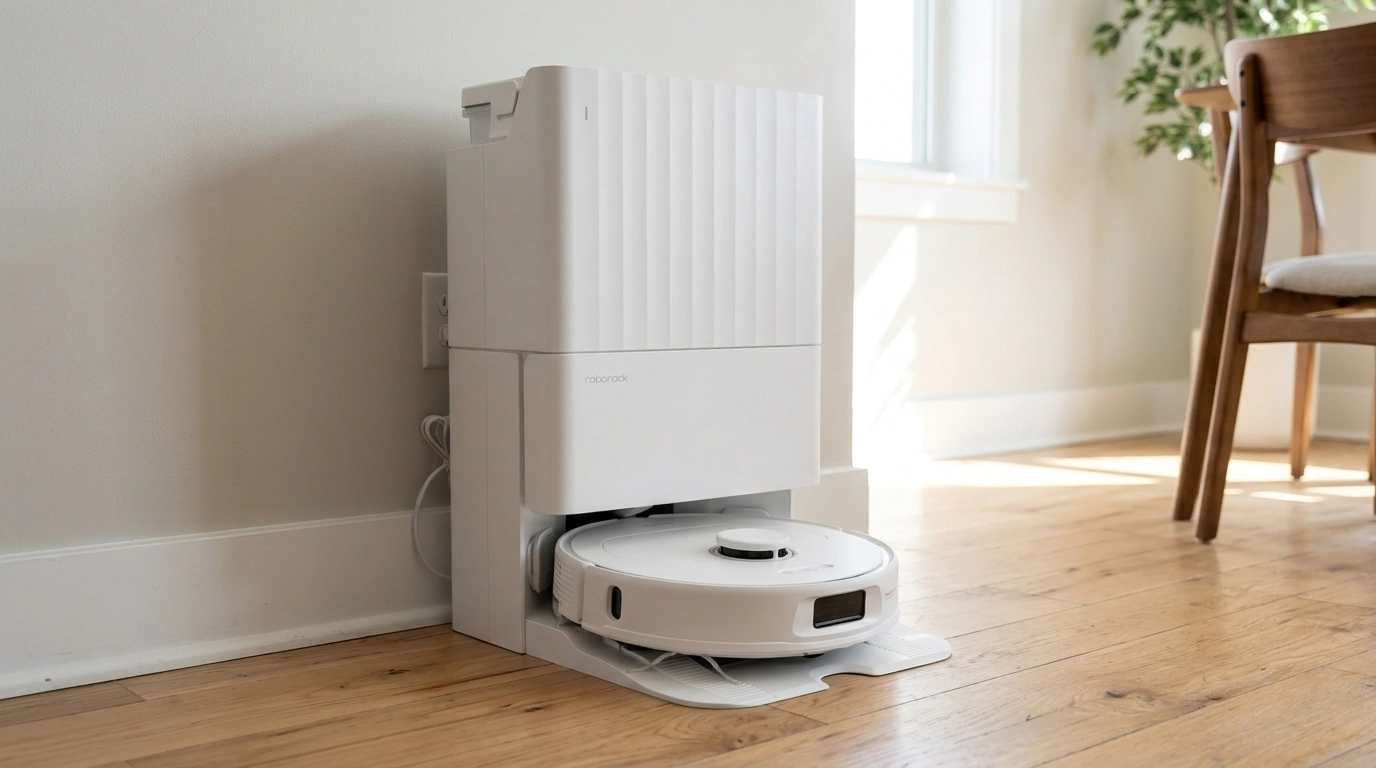 The benchmark illustrative example for dual spinning mops, 7mm auto-lift, and all-in-one hands-free dock automation.
1. Roborock Q Revo: Best Example of Flagship Spinning Mopping & Auto-Wash Automation
- Navigation: PreciSense LiDAR laser turret with reactive 3D structured light
- Mopping System: Dual rotating mops spinning at 200 RPM with 7mm automatic carpet lift
- Suction Rating: 5,500 Pa extreme suction with all-rubber anti-tangle roller
- Dock Capabilities: Auto-empty dustbin, mop washing, 113°F warm air drying, clean water tank refilling
- Dustbag Capacity: 2.7 Liters (holds up to 7 weeks of debris)
The Roborock Q Revo demonstrates how modern flagship engineering tackles mixed hard-and-carpeted living spaces. Unlike older hybrid models that drag a damp static pad across rugs, the Q Revo uses dual pressurized spinning microfiber pads that lift 7mm into the air the moment ultrasonic sensors detect an area rug, allowing it to vacuum carpets and mop hardwood in a single autonomous run.
Compared to the camera-based iRobot Roomba j7+, the Q Revo prioritizes hard-floor wet cleaning. Its multi-function dock washes the rotating mop pads against a textured cleaning base, empties collected dry debris into an enclosed 2.7-liter bag, and circulates warm air across the damp pads to eliminate sour bacterial mildew smells. The structured-light sensor navigates dining chairs and table legs gracefully, though it is slightly less reliable on tiny black charging cables than full optical AI cameras.
Pros
- Dual rotating mops scrub dried coffee spills and muddy footprints rather than just dragging water
- Automatic 7mm mop lift prevents damp cloths from wetting low-pile area rugs during vacuum cycles
- All-in-one dock washes, warm-air dries, and empties the robot with minimal weekly user interaction
- LiDAR laser turret maps large multi-room homes in minutes and operates flawlessly in pitch darkness
Cons
- All-in-one docking station occupies significant floor space and requires nearby electrical outlet access
- Structured light obstacle avoidance occasionally misses thin black phone cables on dark rugs
- Clean and dirty water tanks require regular refilling and rinsing every 4 to 7 days
Get this if: You have extensive hardwood or tile flooring, pets that track dirt, and want a machine that vacuums and genuinely scrubs floors with minimal human intervention. Skip this if: You live in a compact studio apartment without room for a large dock, or have thick 15mm shag carpeting throughout.
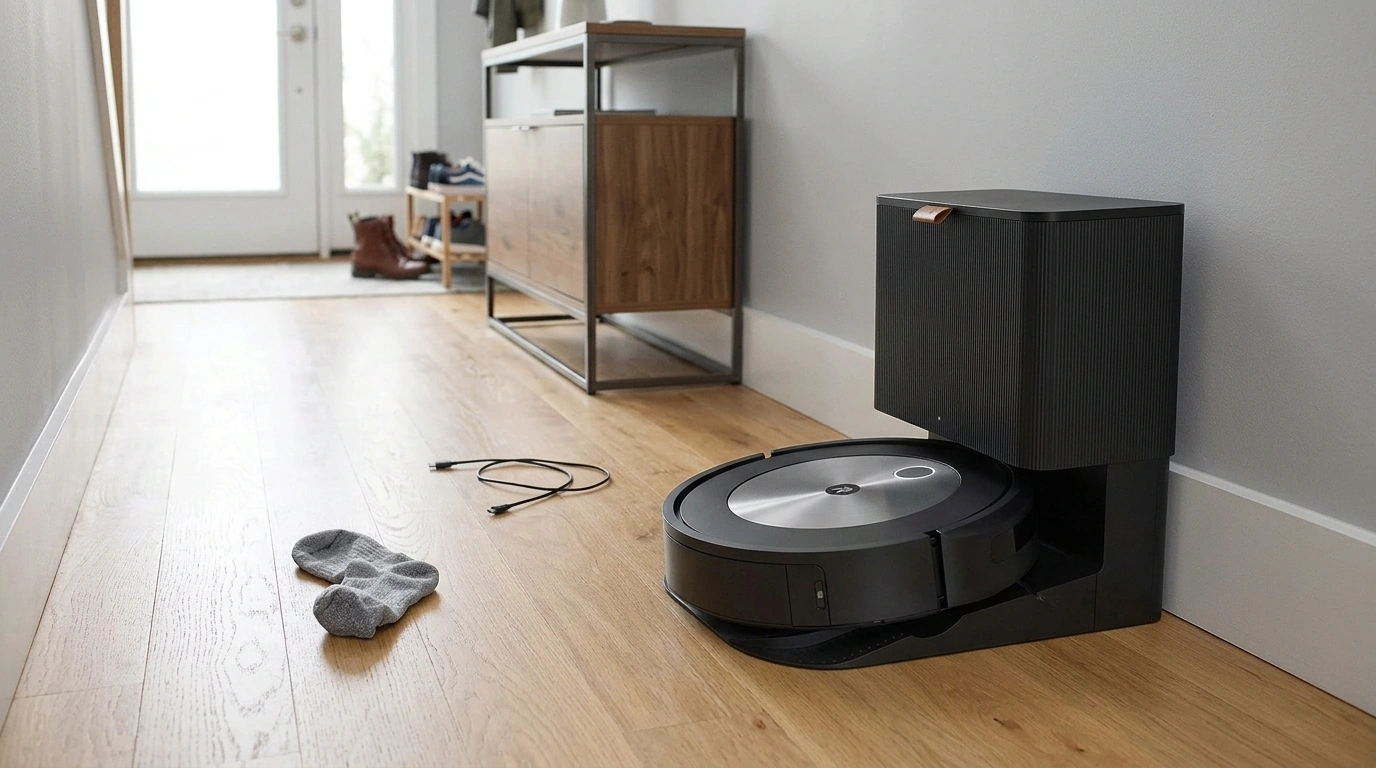 The industry benchmark for front-facing AI camera obstacle avoidance, dodging charging cords and pet waste with complete confidence.
2. iRobot Roomba j7+: Best Example of AI Camera Cable & Pet Waste Avoidance
- Navigation: PrecisionVision optical RGB camera with onboard AI neural network
- Obstacle Detection: Actively recognizes and steers around cables, pet waste, socks, and shoes
- Suction System: Dual multi-surface rubber roller brushes with 10x air power lift
- Docking Station: Clean Base Automatic Dirt Disposal with low-profile horizontal design
- Dustbag Capacity: Holds up to 60 days of pet hair and dirt in sealed AllergenLock bags
If your daily living reality involves dropped iPhone charging cables, stray socks, and unpredictable puppy accidents, buying a standard laser robot is a recipe for disaster. The iRobot Roomba j7+ is the clearest consumer example of computer vision obstacle avoidance. Rather than relying on a top-mounted laser turret, it places an active optical RGB camera directly in the front bumper, illuminated by an integrated LED headlight.
Unlike the mop-focused Q Revo, the j7+ is a dry-vacuum specialist. The front camera routes around cords and pet accidents more reliably than laser-only bots, and the low Clean Base fits under many console tables where tall wash docks will not.
Pros
- Industry-leading AI obstacle recognition avoids charging cables, socks, and pet accidents reliably
- Dual counter-rotating rubber rollers do not tangle with pet hair like traditional bristle brushes
- Compact, low-profile Clean Base dock fits comfortably beneath existing furniture and console tables
- Front LED headlight illuminates dark corridors and under-furniture shadows for reliable navigation
Cons
- Standard model lacks mopping capability entirely (requires step-up to Combo model with dragging pad)
- Clean Base auto-empty cycle generates a loud 82 dB motor roar for 15 seconds during docking
- Relies on ongoing purchases of proprietary AllergenLock disposable dust bags
Get this if: Your household frequently has phone charging cords, shoes, or pet hazards on the floor, and you want dependable dry vacuuming with zero pre-cleaning hassle. Skip this if: You want active pressurized hard-floor mopping or prefer reusable bagless dust collection.
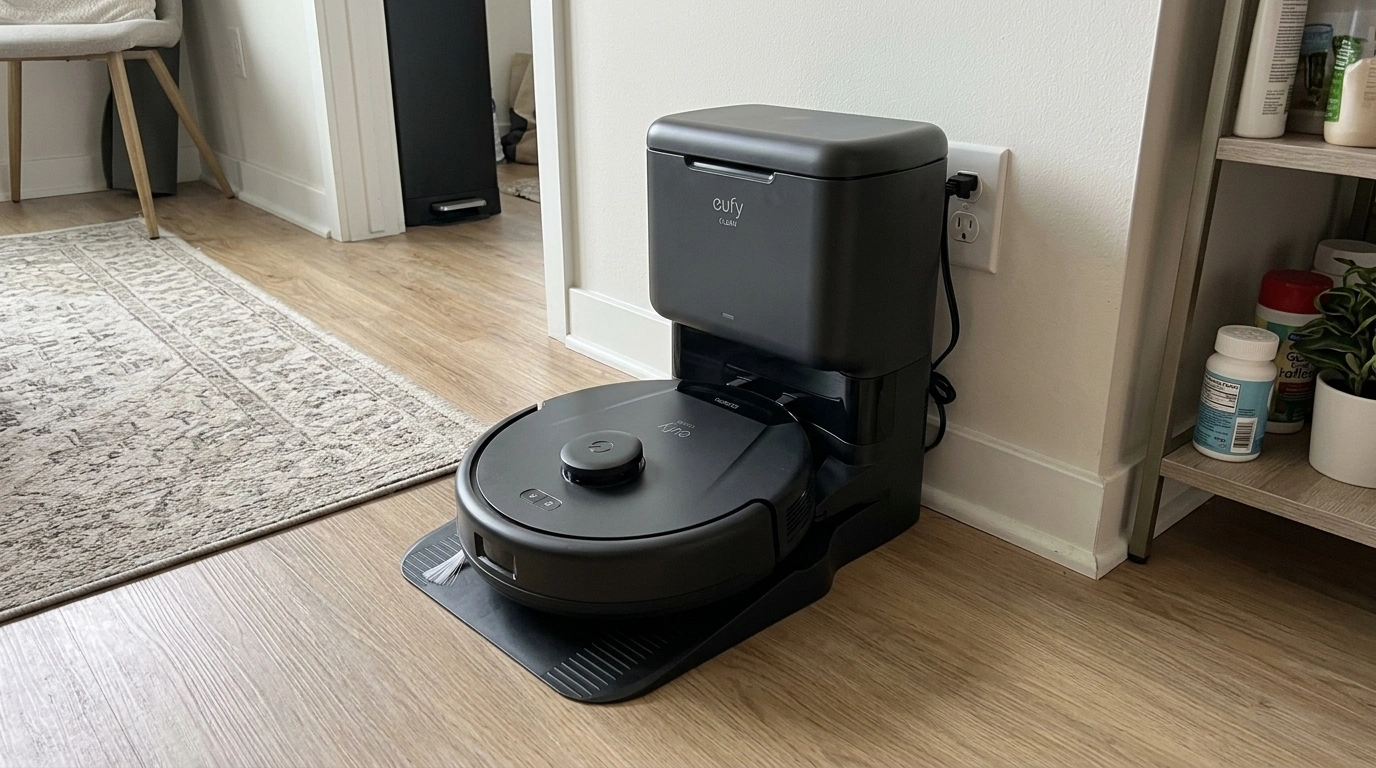 The prime example of accessible mid-range LiDAR laser mapping paired with 5,000 Pa suction and hands-free auto-emptying under $400.
3. eufy Clean L60 with Self-Empty Station: Best Example of Mid-Range LiDAR Value
- Navigation: iPath LiDAR laser turret with multi-floor mapping support
- Suction Rating: 5,000 Pa ultra-strong suction with Hair-Detangling technology
- Docking Station: Auto-Empty Station with 2.5-liter sealed dust bag (holds up to 60 days)
- Brushroll Design: Hair-detangling roller that reverses rotation to slice tangled fur
- App Features: Customizable room cleaning, virtual no-go zones, and selective zone sweeps
You do not need to spend $800 to enjoy the time-saving benefits of accurate laser navigation and automated dustbin emptying. The eufy Clean L60 demonstrates how mid-range engineering delivers core smart vacuum capabilities at an accessible sub-$400 price point. Its top-mounted iPath LiDAR turret builds precise multi-room floor plans on its initial voyage, allowing you to schedule specific room cleaning routines directly from your smartphone.
Unlike the Q Revo, the L60 skips water tanks and spinning mops and focuses on dry cleaning. 5,000 Pa helps with litter and pet hair on low-to-medium pile, and the vertical auto-empty tower uses roughly half the floor space of an all-in-one wash dock.
Pros
- iPath LiDAR navigation creates accurate multi-room floor plans and cleans in neat rows
- Strong 5,000 Pa suction pulls dense debris and pet hair out of low-to-medium pile rugs
- Auto-empty station holds up to 60 days of dirt in a compact footprint suitable for small homes
- Clean smartphone app lets you draw virtual boundaries and no-go zones with precision
Cons
- Lacks front-facing optical AI cameras and will push loose charging cables rather than avoiding them
- Standard configuration lacks wet mopping capabilities
- Plastic chassis and bumper assembly feel slightly lighter and more utilitarian than flagship rivals
Get this if: You want fast LiDAR room mapping, strong suction for pet hair, and hands-free dustbin emptying without paying flagship prices. Skip this if: You want an automated floor scrubber with hot-water mopping, or have floors cluttered with loose charging wires.
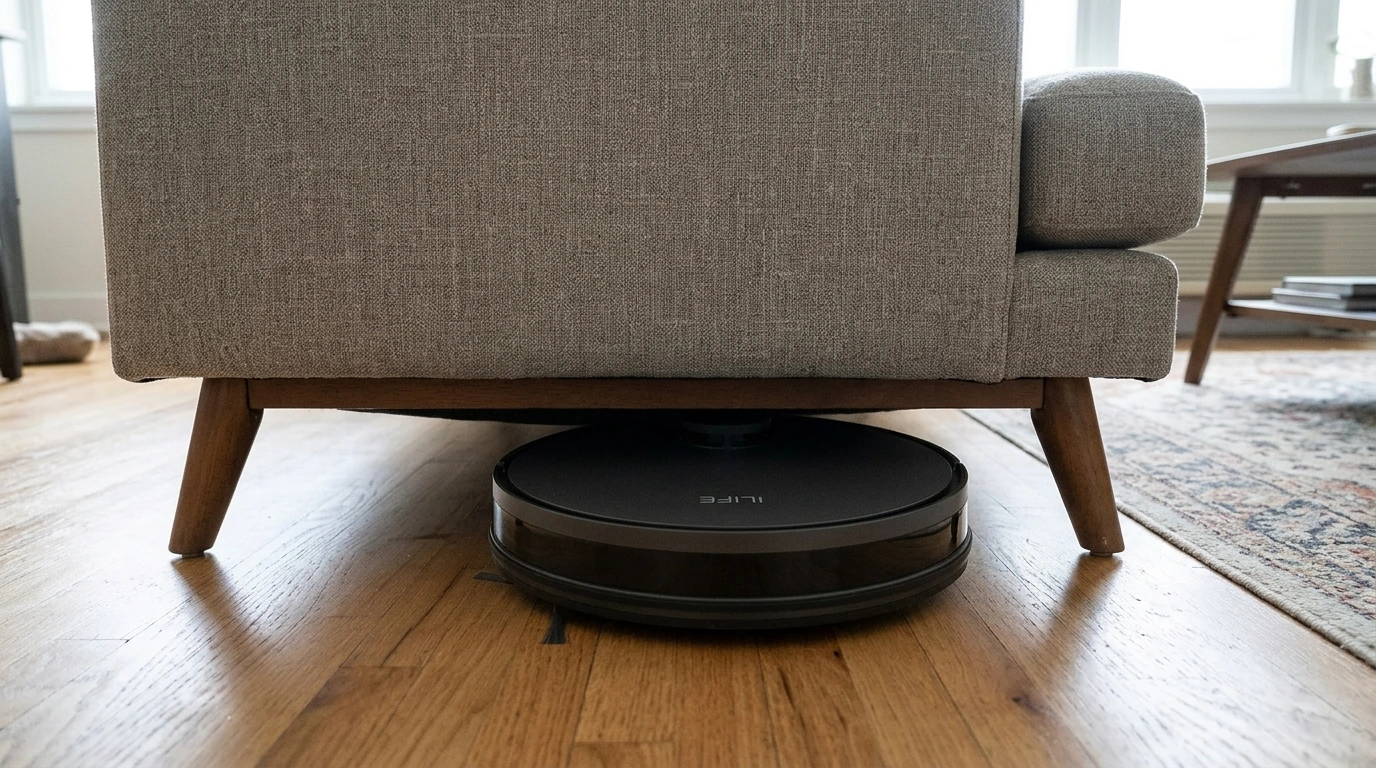 The classic example of ultra-slim budget bounce navigation that slides beneath low sofas where tall LiDAR turrets cannot fit.
4. ILIFE V3s Pro: Best Example of Ultra-Slim Low-Clearance Budget Simplicity
- Navigation: Infrared bump-and-bounce obstacle sensors with cliff detection
- Profile Height: Ultra-slim 2.85-inch low-profile chassis
- Cleaning Mechanism: Tangle-free direct suction inlet with dual spinning side sweepers
- Controls: Wireless infrared remote control plus single one-touch auto clean button
- Battery Runtime: Up to 100 minutes of continuous hard-floor cleaning per charge
While tech enthusiasts gravitate toward laser turrets and smartphone apps, complex connectivity is not always necessary for clean floors. The ILIFE V3s Pro serves as the classic proof-of-concept for budget simplicity. Standing a remarkably slim 2.85 inches tall, it effortlessly glides underneath low-profile platform beds, mid-century sofas, and low entertainment credenzas where tall 4-inch LiDAR turrets physically wedge and get stuck.
Unlike the mapped eufy L60, the V3s Pro bounce-navigates in straight runs until it taps an obstacle, then turns. A direct suction inlet (no center brushroll) pulls pet fur into the bin with less hair wrap, which cuts brush-cleaning chores.
Pros
- Ultra-slim 2.85-inch profile glides under low platform beds and sofas that block LiDAR turrets
- Direct suction inlet will not tangle with long pet hair, eliminating roller maintenance
- Inexpensive entry-level price point under $180 provides automated cleaning on a strict budget
- Zero Wi-Fi, app, or cloud dependencies: operates reliably via an included physical remote control
Cons
- Random bounce navigation cleans inefficiently and cannot save maps or target specific rooms
- Requires manual dustbin emptying after every cleaning session due to compact 0.3L bin size
- Not suitable for medium or high-pile carpeting; strictly intended for hard floors and low flat rugs
Get this if: You live in an apartment with low-clearance furniture, shed lots of pet hair on hardwood or tile, and prefer simple remote-control operation over mobile apps. Skip this if: You have a large multi-room home requiring room-by-room mapping, or own medium-to-deep carpeting.
Home Layout Checklist: What to Measure Before You Buy
1. Door Threshold Heights
Measure the transition strips between your kitchen tile, hallway hardwood, and bathroom entries. Most modern robot vacuums climb thresholds up to 20mm (0.78 inches). If your home has raised wooden bevels or marble transition sills exceeding 22mm, the robot will treat the doorway as a solid wall and refuse to enter the room without manual lifting.
2. Furniture Undercarriage Clearance
Measure under-sofa and under-bed gaps. LiDAR turrets usually need about 3.9–4.2 inches. Below that, look at low-profile camera bots (Roomba j7+ class) or ultra-slim direct-suction units (ILIFE V3s Pro class).
3. Carpet Pile Depth and Area Rug Tassels
Check rug tassels and fringe: they snag side brushes. Deep shag over ~15mm can bog drive wheels, and 7–10mm mop lifts may still drag damp pads on thick pile.
4. Dock Placement Real Estate
All-in-one docks need clear space: roughly 1.5 ft on each side and 3–4 ft in front, plus a wall outlet that does not block a hallway or kitchen walkway.
Final Decision Checklist: Finding Your Match
- Pick a Flagship Multi-Function Robot (e.g. Roborock Q Revo) if: You have extensive hardwood or tile, active pets tracking mud, open dock space, and want automated vacuuming and pressurized mopping with minimal daily maintenance.
- Pick an AI Camera Specialist (e.g. Roomba j7+) if: Your floors frequently have charging cables, socks, or pet waste hazards, and you want dependable dry vacuuming without tedious pre-cleaning.
- Pick a Mid-Range LiDAR Value (e.g. eufy Clean L60) if: You want fast laser room mapping, virtual app boundaries, and 60-day auto-empty dust storage under $400.
- Pick an Ultra-Slim Budget Bumper (e.g. ILIFE V3s Pro) if: You live in a compact apartment with low furniture under 3 inches tall, clean mostly hard floors, and want simple remote-control operation under $180.